Intelligent Link Switching (ILS) function has been launched in AXESDN 33 global POPs (Point of Presence)

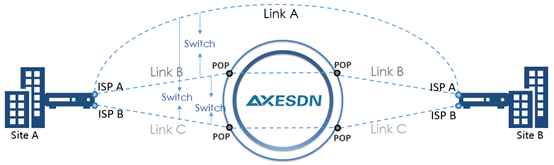
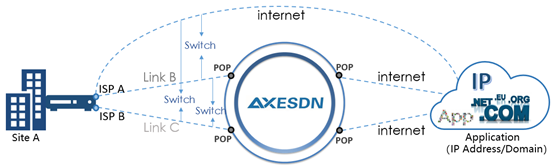
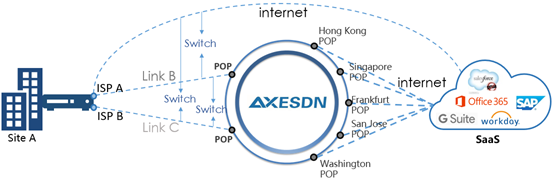
ILS (Intelligent Link Switching) can be applied to AXESDN's NaaS (Network as a Service), ANOS (AXESDN Network Optimization Service) and ASAS (AXESDN SaaS Acceleration Service) solutions. ILS not only leverage multi-redundancy resources such as AXESDN global POP, L2 core networks, and internet access on customer sites to set up a HA hybrid network, but also monitor the quality of each link through the AXESDN platform. The link selection policy can be defined for individual application according to the link quality (latency/packet loss rate) and AXESDN SD-WAN platform can make the application always selecting the link with better quality for data transition. ILS can empower the overall network solution to achieve higher availability and application performance with lower TCO (Total Cost of Ownership).
NaaS with ILS (Intelligent Link Switching)
ANOS with ILS (Intelligent Link Switching)
ASAS with ILS (Intelligent Link Switching)
Functions of ILS (Intelligent Link Switching):
• Link mode:
a) Load balancing (active/active. Load sharing & can ensure that the application always select the link with better quality)
b) Active/standby (applications select the active link as default, and when the active link quality (latency/packet loss rate) is worse than expected, SD-WAN platform will do link switching to activate the standby link and switch the traffic to the new active link.
c) Load balancing + active/standby (active/active/standby)
• link Switching mode:
a) Manual switching (through manual intervention to achieve link switching)
b) Automatic switching (automatic switching according to a pre-defined policy)
I. Switching according to the status of links (up/down)
II. Switching according to the packet loss rate of the link
III. Switching according to the latency of the link
IV. Switching according to bandwidth utilization of the link
c) Preemption mode
I. Preemption Mode (On)-After link switching occurs, if the active (high priority) link quality returns to the defined "healthy state", the system will automatically switch back to the active link.
II. Preemption Mode (Off)-After the link switching occurs, even if the active (high priority) link quality returns to the defined "healthy state", the system will not automatically switch back immediately. You can only switch back automatically after the backup link fails, or manually switch back at any time.
Why ILS (Intelligent Link Switching) can empower the overall network solution to achieve higher availability and application performance with lower TCO?
1. ILS not only provides multiple redundant link solution, but also leverage the real-time health check of the platform, to trigger link switching which reduce the downtime of routing. It can achieve automatically immediate switching when problem happens, which is more intelligent and efficient than manual operation.
2. ILS supports kinds of link switching policies (link up/down status, packet loss rate, latency, and bandwidth utilization), which can better support the application than other hybrid WAN solutions to ensure the performance and availability of the application.
3. The Internet is more cost-effective than a dedicated line ILS (Intelligent Link Switching) maximizes the utilization rate of the Internet and improves the cost-effectiveness of the overall network solution while ensuring application performance.